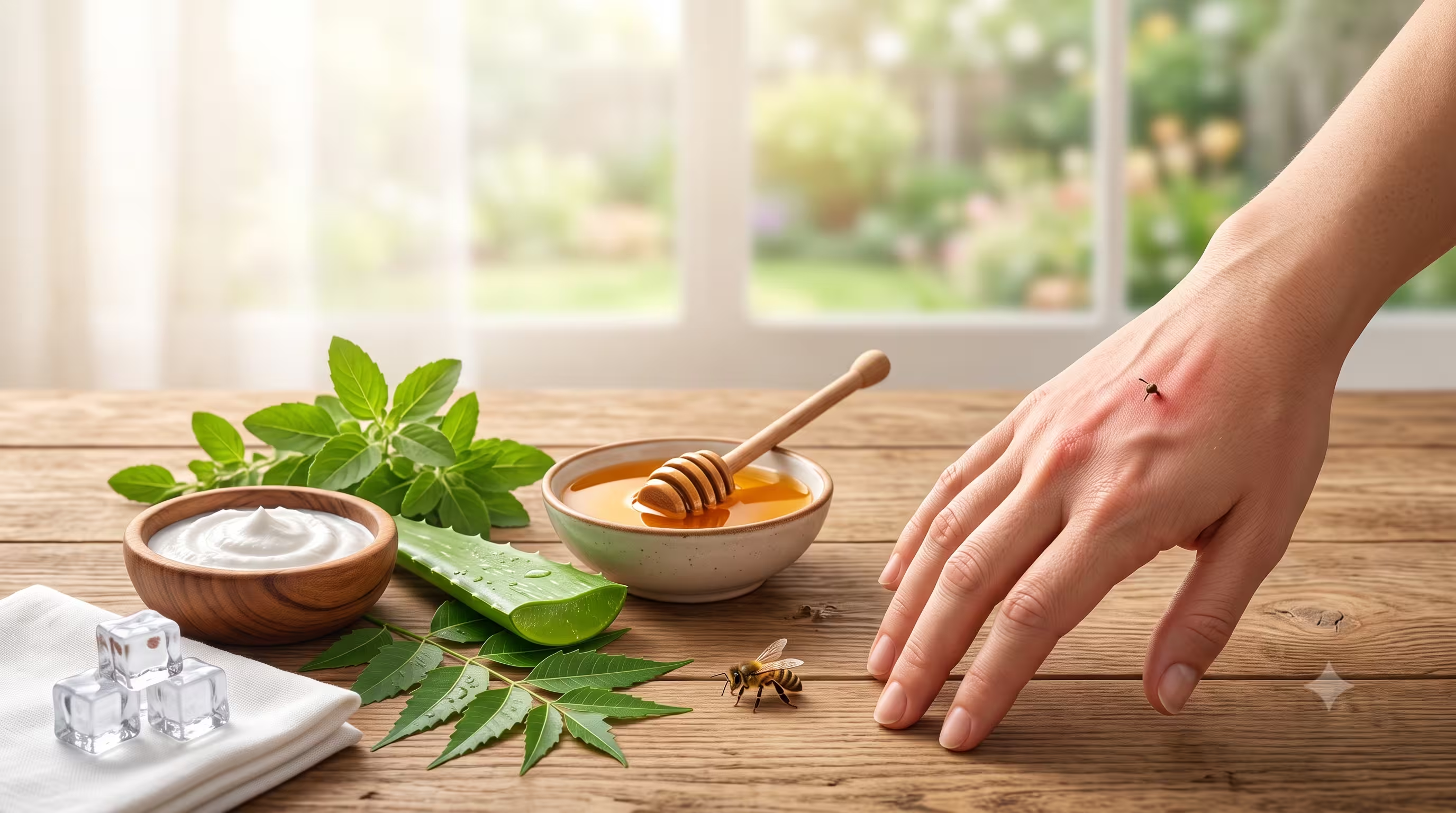
A bee sting can cause sudden pain, burning, redness, and swelling within seconds. Although most bee stings are mild, knowing what to do immediately can make a big difference. The first priority is removing the bee stinger as quickly as possible, followed by simple first aid to help manage the sting.
In this guide, you'll learn how to treat a bee sting at home, remove a bee stinger safely, reduce swelling, explore traditional home remedies that have been used for generations, understand what to expect during recovery, and know when it's time to seek medical care.
⚠️ Medical Emergency: Seek immediate medical attention if you develop difficulty breathing, swelling of the face, lips, tongue, or throat, widespread hives, dizziness, fainting, or if you have been stung multiple times.
📑 Table of Contents
How to Remove a Bee Stinger Safely
Removing the stinger is the most important part of bee sting treatment. Unlike a wasp, a honey bee usually leaves its stinger behind in the skin. The stinger can continue releasing venom for a short time after the sting, so removing it as quickly as possible may help reduce pain and swelling.
Follow these simple steps to remove a bee stinger safely:
- Act Quickly: Remove the stinger as soon as you notice it. The sooner it is removed, the less venom may enter the skin.
- Use Your Fingernail or a Card: Place your fingernail or the edge of an ATM/credit card flat against your skin and gently slide it toward the stinger until the stinger comes out.
- Avoid Crushing the Stinger: Do not squeeze or crush the stinger while removing it, as this may release more venom into the skin.
- Wash the Area: After removing the stinger, wash the area with mild soap and water.
Tip: > Tip: If you're wondering how to remove a honey bee sting, remove the stinger as quickly as possible using your fingernail or the edge of a credit card instead of pulling or squeezing it.
Apply Slaked Lime (Chuna, Chunnambu) as a Traditional Home Remedy
Our Family's Experience
This traditional remedy has been used in our family for many years. When my sister's son was stung by a honey bee, we first removed the stinger and then applied a small amount of slaked lime paste around the sting site. In our experience, the burning sensation gradually eased, and the swelling settled without any complications.
This is a traditional home remedy that worked well in our family's experience. However, its effectiveness has not been well established by scientific research.
How to Use Slaked Lime
- Prepare the Paste: Take a small pinch of slaked lime and mix it with a few drops of clean water to make a smooth paste.
- Apply Gently: Spread a thin layer over and around the bee sting after the stinger has been removed.
- Leave It On: Allow the paste to remain on the skin for 15–30 minutes before gently washing it off if desired.
Important: Slaked lime should only be applied to intact skin. Do not use it on open wounds, near the eyes, or on sensitive areas. If irritation develops, wash it off immediately with clean water.
For additional bee sting swelling treatment, you can also apply a cold compress for 10–15 minutes to help reduce pain and swelling.
Other Natural Home Remedies for Bee Sting Relief
Besides slaked lime, several other traditional and natural remedies are commonly used to soothe mild bee stings. While some of these remedies may help relieve pain, burning, or swelling, scientific evidence supporting their effectiveness is limited. They should be used only after the stinger has been removed and should never replace medical care for severe allergic reactions.
1. Cold Compress
A cold compress is one of the most effective first-aid measures for a bee sting. Applying a cloth-wrapped ice pack to the affected area for 10–15 minutes helps reduce pain, burning, and swelling. Avoid placing ice directly on the skin to prevent cold injury.
2. Aloe Vera Gel
Fresh aloe vera gel is widely used to soothe irritated skin. Its cooling effect may help reduce the burning sensation caused by a bee sting while keeping the skin moisturized. Apply a thin layer of fresh aloe vera gel to clean, intact skin.
3. Tulsi (Holy Basil)
In many Indian households, freshly crushed Tulsi (Holy Basil) leaves are applied to minor insect stings because they provide a cooling and soothing sensation. Although scientific studies on bee stings are limited, Tulsi has been used in traditional medicine for generations.
4. Neem Paste
Neem leaves are traditionally valued for their skin-soothing properties. A fresh neem leaf paste is sometimes applied to mild bee stings as a home remedy. Use it only on intact skin, and wash it off if irritation occurs.
5. Honey
Some people apply a small amount of pure honey to minor bee stings because of its soothing and moisturizing properties. However, scientific evidence supporting its effectiveness for bee sting treatment is limited, so it should be considered a traditional remedy rather than a medically proven treatment.
Wasp Sting vs. Bee Sting: What's the Difference?
Although people often use the terms interchangeably, bee stings and wasp stings are not the same, and the first-aid approach differs slightly.
| Bee Sting | Wasp Sting |
|---|---|
| Usually leaves the stinger behind | Usually does not leave a stinger behind |
| Typically stings only once | Can sting multiple times |
| Remove the stinger immediately | Wash the area and apply a cold compress |
| Mild stings can often be managed with home care | Mild stings can often be managed with home care |
Wasp Sting First Aid
If you have a wasp sting, wash the affected area with soap and water, apply a cold compress for 10–15 minutes, and keep the area clean. Most mild wasp stings improve with simple home care over the next few days.
Traditional Wasp Bite Home Remedy
In many Indian households, crushed Tulsi (Holy Basil) leaves or Neem paste are traditionally applied to mild wasp stings to provide a cooling sensation and soothe irritated skin. While these remedies have been used for generations, scientific evidence supporting their effectiveness for wasp stings is limited. If you choose to try them, apply them only to intact skin and discontinue use if irritation develops.
⚠️ Important: Seek immediate medical care if you develop difficulty breathing, severe swelling, widespread hives, dizziness, or if you are stung multiple times.
Bee Sting Swelling Treatment: How to Reduce Pain and Swelling
Swelling is a normal reaction after a bee sting. For most people, the affected area becomes red, painful, and swollen within a few minutes. The swelling usually reaches its maximum within 24 to 48 hours before gradually improving over the next few days.
Here are some simple ways to reduce swelling after a bee sting:
- Apply a Cold Compress: Place an ice pack or a cloth wrapped around ice on the sting for 10–15 minutes at a time. This helps reduce pain and swelling.
- Keep the Area Elevated: If the sting is on your hand or foot, raising the affected limb may help minimize swelling.
- Avoid Scratching: Scratching can further irritate the skin and increase the risk of infection.
- Keep the Area Clean: Wash the sting site with mild soap and water to help prevent infection.
- Monitor the Swelling: Mild swelling is common and usually improves within a few days.
Note: Some people experience a larger local reaction, where swelling spreads beyond the sting site. Although this can look alarming, it often settles on its own. However, if the swelling continues to worsen after 48 hours, or if you develop fever, pus, increasing redness, or severe pain, consult a healthcare professional.
Bee Sting Swelling After 48 Hours: Is It Normal?
In most cases, yes. It is common for bee sting swelling to become more noticeable during the first 24–48 hours before it gradually starts improving. A large local reaction can sometimes cause swelling that extends beyond the sting site and may take up to a week to resolve.
You should continue to monitor the affected area during this time.
Mild swelling is usually normal if:
- The swelling has stopped getting worse.
- Pain and burning are gradually improving.
- There is no pus or fluid coming from the sting site.
- You do not have fever or other signs of illness.
Seek medical attention if:
- The swelling continues to increase after 48 hours.
- You notice pus, increasing redness, or warmth around the sting.
- You develop fever or severe pain.
- The swelling affects your eyes, lips, tongue, or throat.
- You experience difficulty breathing, dizziness, or widespread hives.
Most uncomplicated bee stings heal within a few days, although mild itching and swelling may persist for up to a week in some people.
How Long Does Bee Venom Stay in Your System?
For most people, the venom from a bee sting acts quickly at the sting site. The sharp pain and burning usually begin within seconds, while redness and swelling often develop over the next few hours. Your body's immune system then gradually breaks down and clears the venom over time.
Although the venom itself does not remain active for long, your immune response can continue for several days. This is why some people still experience itching, redness, or mild swelling even after the venom has been cleared.
Typical Recovery Timeline
| Time After the Sting | What You May Experience |
|---|---|
| Within seconds | Sharp pain and burning |
| 30 minutes to a few hours | Redness and swelling begin |
| 24–48 hours | Swelling often reaches its peak |
| 3–7 days | Most mild bee stings improve significantly |
| Up to 10 days | Large local reactions may take longer to settle |
Everyone reacts differently. Children, people with sensitive skin, and those who experience a large local reaction may notice symptoms lasting longer than others. However, if symptoms continue to worsen instead of improving, or if signs of infection develop, seek medical advice.
What Does Bee Venom Contain? Does a Bee Sting Contain Acid?
Many people wonder whether a bee sting contains acid or if honey bee venom is acidic. This is a common question because traditional home remedies often mention using alkaline substances such as slaked lime (chuna or chunambu).
The truth is that bee venom is much more complex than a single acid. It contains a mixture of biologically active substances, including proteins, peptides, enzymes, and small molecules that trigger pain, inflammation, and your body's immune response.
Some of the major components of bee venom include:
- Melittin – the primary peptide responsible for pain and inflammation.
- Phospholipase A2 – an enzyme that contributes to tissue irritation and allergic reactions.
- Hyaluronidase – an enzyme that helps the venom spread through surrounding tissues.
- Histamine and other compounds – substances that contribute to redness, itching, and swelling.
Does a Bee Sting Contain Formic Acid?
A common belief is that bee venom mainly contains formic acid. While traces of organic acids may be present, modern scientific research shows that the pain and swelling from a honey bee sting are primarily caused by proteins, peptides, and enzymes—not by formic acid alone.
This is why there is limited scientific evidence that applying an alkaline substance can "neutralize" bee venom. However, some traditional remedies continue to be used because people find them soothing or comforting after mild bee stings.
How Does the Honey Bee's Stinger Work?
A honey bee has a barbed stinger connected to a small venom sac. When the bee stings, the barbed stinger becomes lodged in the skin, and the attached venom sac may continue releasing venom for a short time. This is why removing the stinger as quickly as possible is considered the most important first-aid step.
When Should You See a Doctor for a Bee Sting?
Most bee stings cause only mild pain, redness, and swelling that improve with home care over the next few days. However, some reactions require prompt medical attention and should not be treated with home remedies alone.
Seek emergency medical care immediately if you experience:
- Difficulty breathing or wheezing.
- Swelling of the face, lips, tongue, or throat.
- Widespread hives or severe itching away from the sting site.
- Dizziness, fainting, or confusion.
- A rapid heartbeat or chest tightness.
- Multiple bee stings, especially in children or older adults.
These symptoms may indicate a severe allergic reaction (anaphylaxis), which is a medical emergency.
Contact your healthcare provider if:
- Swelling continues to worsen after 48 hours.
- You notice increasing redness, warmth, pus, or fever, which may suggest an infection.
- The sting is near the eyes, inside the mouth, or in another sensitive area.
- Pain or swelling does not improve after several days.
- You have concerns because of an underlying medical condition or a previous allergic reaction to insect stings.
Remember: Home remedies and first aid are suitable only for mild bee stings. If symptoms become severe or you suspect an allergic reaction, seek medical attention immediately rather than relying on home treatment.
Frequently Asked Questions
How do you treat a bee sting at home?▼
What is the best home remedy for a bee sting?▼
How long does bee sting swelling last?▼
Is bee sting swelling after 48 hours normal?▼
Which acid is present in a bee sting?▼
How long does bee venom stay in your system?▼
Do bumble bees sting?▼
When should I see a doctor after a bee sting?▼
⚠️ Disclaimer: This article is for educational purposes only and should not replace professional medical advice. Home remedies may provide comfort for mild bee stings, but reactions vary from person to person. If symptoms are severe or you suspect an allergic reaction, seek immediate medical care
Related Blogs
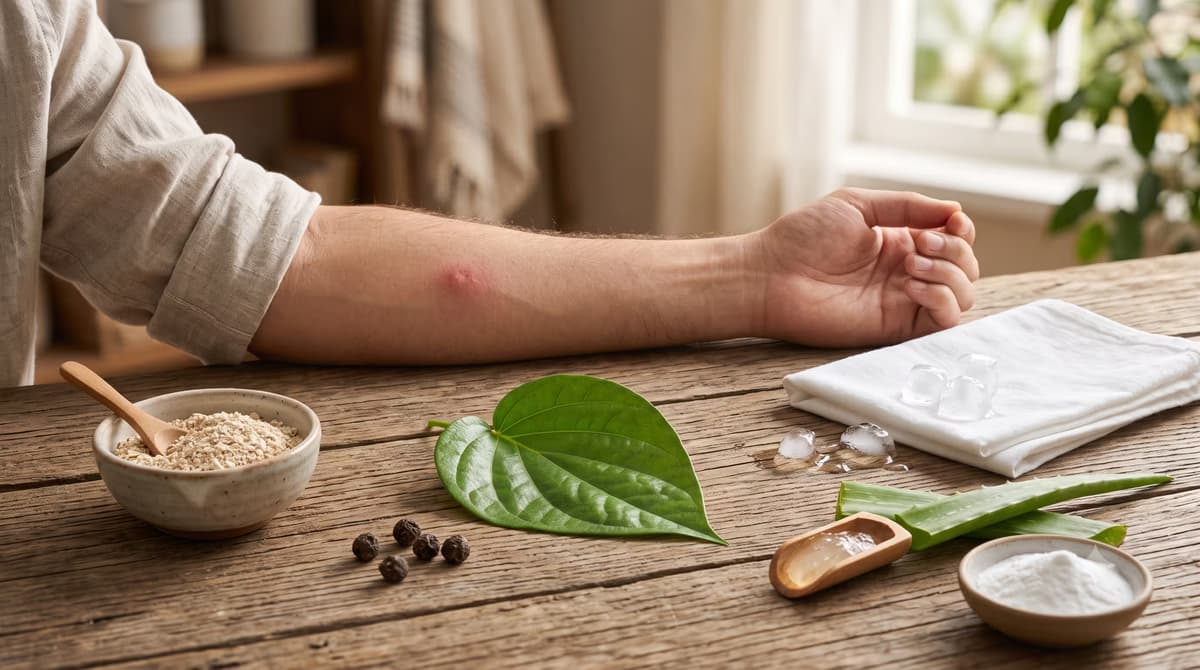
Home Remedies for Insect Bites: Natural Ways to Relieve Itching & Swelling
Discover home remedies for insect bites, including a traditional betel leaf remedy, plus natural ways to relieve itching, swelling, and skin irritation.
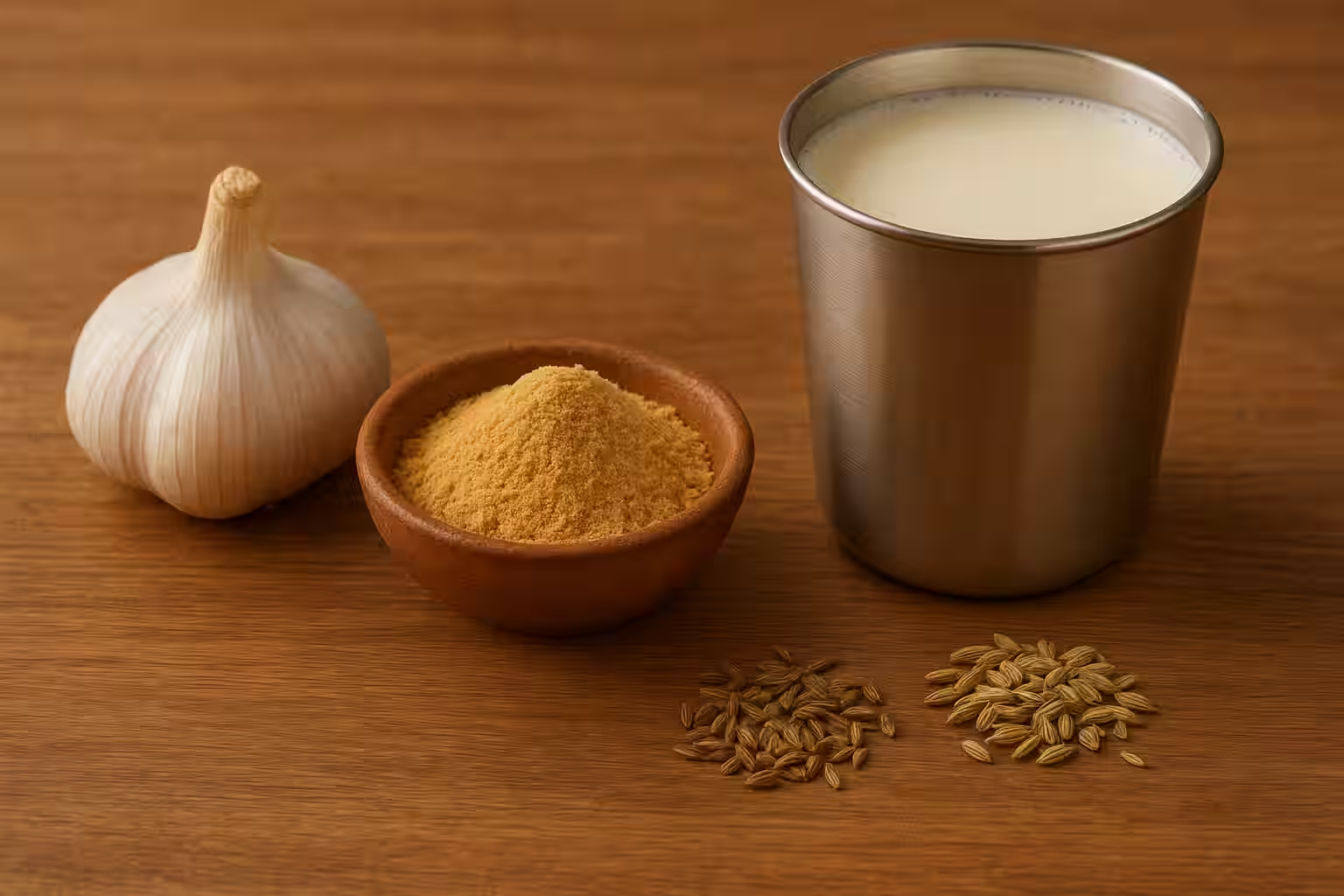
Home Remedies for Gastric Problem: Natural Relief for Gas, Bloating & Indigestion
Discover simple and effective home remedies for gastric problem. Learn how Vellapoodu (hing) and Ajwain help relieve gas, bloating, and indigestion naturally at home.

First Aid for Burns: Hot Oil and Hot Water Burn Treatment
Learn first aid for burns caused by hot oil and hot water. Discover immediate steps, home care tips, our family's potato remedy, and when to seek medical help.